Misse Eln
Systema Delenda EstMisse Eln is the Eln clan’s formidable Core Greater Deity and the daughter of the clan’s Patriarch, Keppel Eln. She becomes the central antagonist of the System’s late crisis by converting a campaign against Cato into an institutional seizure of power: first as Muar’s exacting patron, then as the hidden claimant to the True Core, and finally as the ruler of a shrinking System whose resources fail before her authority can become secure.
Identity and Position
Misse Eln first appears beyond the mortal plane, where she and another previously unseen being receive Muar after his Crusade has attracted divine notice. She recognizes the value of his campaign against Cato and offers him elevation to the Chosen, explicitly linking his advancement to cooperation with her. Muar accepts by kneeling before her, and Misse immediately reframes the arrangement as practical work: they will discuss the crises Cato has caused, the worlds that must be considered, and those that might be suborned.
Her formal status places her far above Muar. Misse is a Greater Core Deity, two full steps above his Deity rank, and the direct daughter of Keppel Eln. Working for her should therefore be an honor, but her stringent demands and miserly rewards make the appointment function as a punishment known to everyone around her. Muar’s reputation is already damaged by his losses to Cato, his essence reserves are barely stable, and his technical promotion has stalled; under Misse, those failures become grounds for relentless pressure rather than sympathy. The family connection does not soften her authority. As Muar’s aunt, she is instead described as terrifying.
Patronage and the Campaign Against Cato
Misse appoints Muar as her Blessed among the mortal worlds and gives him an administrative mandate rather than a merely military one. At a meeting in the Forsythe Courtyard, she explains that the recent purge of Gyvestral has demonstrated the need for patience and thoroughness. Every world, including worlds belonging to other Clans, must be audited and considered. Muar is to ensure that Planetary Administrators and Temples coordinate and take the danger seriously.
The appointment reveals the breadth of Misse’s political method. She does not treat Cato as an isolated battlefield opponent; she treats his presence as a systemic contamination requiring inspection, coordination, and eventually purification. Her smile during the announcement is associated with hunger and satisfaction, suggesting that bureaucratic oversight is not a reluctant burden for her but a form of power. Muar becomes the instrument through which her authority reaches the mortal worlds, while she remains positioned above the local institutions that must carry out her will.
When Cato’s forces appear across a score of worlds, Misse directs the response from her war room. The assembled gods observe battles through an enormous wall of scry-views, including ground perspectives filled with sparks and distant fireballs and views attuned to the Nexus Shards carried by Azoths, which reveal strange craft in space. Each of Cato’s creations is individually unimpressive, yet their number and simultaneous distribution transform them into a strategic threat. Misse answers that threat with escalation rather than concession. She declares the affected worlds condemned, calling their destruction a necessary sacrifice for understanding and combating the interloper from outside the System, and presents the decision as proof that the Eln clan remains a faithful servant of the System.
Her public confidence masks a growing intelligence problem. When investigations show that Cato has a presence on every Inner World, Misse understands that his reach is not a sequence of local incursions but a networked challenge to the Core itself. Muar objects that Cato may not give them enough time to respond, because every additional world taken by the enemy makes the situation less secure. Misse’s answer is not to retreat from the conflict but to search for a higher level of control.
The True Core and Hidden Ascension
Misse turns to the True Core’s difficult offerings, filtered through Skills and an Interface, and asks for a way to enter it with Muar. The request is itself a wager: she is seeking access to the holiest and most authoritative region of the System rather than another ordinary promotion. When the Interface presents the possibility, she interprets the absence of the elder gods as an invitation. They may have departed to leave their place to a worthy deity of the Core Worlds, and she decides that she is the one courageous enough to trespass into that realm.
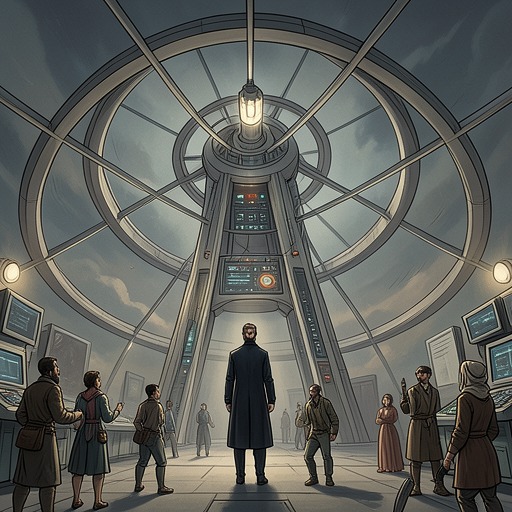
After entering, Misse becomes a True Deity and takes up residence with Muar in an office on the first floor of the essence nexus. She creates the office through her upgraded Interface and decorates it with personal effects and remnants of the prior rulers. The surviving artifacts are inactive fragments and trophies whose Appraise results are nearly incomprehensible; Misse acknowledges that she could devote attention to the ancient history, but the current state of the System has priority. Her first instinct as a new supreme authority is therefore administrative and strategic. Even the relics of forgotten rulers become secondary to managing the present crisis.
Misse does not immediately announce her discovery. Months after entering the True Core, she keeps both her new authority and her status secret. Technical supremacy is not the same as political legitimacy, and she knows that other powers would attempt to undermine her or attack vulnerable members of her family if they understood how much she had gained. Her secrecy is thus not modesty but damage control: she treats revelation itself as a battlefield.
She also uses her new authority selectively. When a proclamation no longer serves her purposes, she simply instructs her Interface to undo it. The act demonstrates how completely the system of command has changed around her, yet Misse still distinguishes between possessing supreme access and being accepted as a leader. That distinction drives her concealment and her continued efforts to consolidate rather than merely proclaim power.
Consolidation, Suspicion, and Rule
Misse believes Cato cannot contest the Core, still less the True Core, and plans to draw the important seeds of the System into the Core before continuing to expand. The plan is defensive and imperial at once. Cato may be present on many worlds, but Misse intends to make the Inner Worlds the decisive reservoir of the future, concentrating what matters where her power is strongest.
Her suspicion of infiltration extends even to her own Clan. When no one takes the bait in an attempted operation, she concludes that the Clan may be uncompromised, but she refuses to treat the result as proof. Nonparticipation could mean many things, and the uncertainty leaves her simultaneously half-mad and half-glad. She hires the only available sensory Alum to investigate Cato’s movements, then receives the conclusion that his presence reaches every Inner World. Intelligence, in Misse’s hands, is never neutral information; it is a reason to tighten control.
At a celebration marking the induction of her own planet into the Core, Misse takes the opportunity to cement relationships and secure what her new station permits. She is not embarrassed that the achievement was accomplished by her own hand, although only Muar knows that fact. The celebration functions as political theater: private knowledge becomes a tool for selective trust, while public ceremony makes annexation appear established and beneficial.
Misse eventually considers abandoning the frontier altogether. It gives the Core essentially nothing, and direct control over annexation makes opening new worlds easier than maintaining distant territory. Her condition is that Cato’s presence must first be fully purged. This logic exposes the narrowness of her sovereignty. She can reorganize the map, absorb worlds, and redefine the center, but every decision remains constrained by the need to locate and eliminate Cato’s influence.
In a public address to honored guests and Clan Elders, she forces the title True Deity to be displayed and announces that the System has chosen her for a grave and transcendent duty. She insists that the System, rather than the Nine Great Clans, must become the focus of effort, while claiming that she does not intend to usurp territory or overturn existing agreements. The statement is both reassurance and warning. Misse presents centralization as service to the System, but the new title makes clear that she is the person through whom that centralization will operate.
Final Crisis and Ending
Cato addresses her without an honorific and directly attributes the sudden absorption of Mishkell and the collapse of the frontier to her consolidation of power. Muar reacts inwardly to the disrespect, while Misse must confront an opponent who recognizes the political consequences of her actions. She does not generally believe in fortuity. As a True Deity and ruler of the System, she sees the System as rarely operating by chance, granting rewards to those who earn them and enmity to those who deserve it. Yet Muar’s words produce a deep sense of foreboding, suggesting that her confidence in systemic order has begun to fracture.
The fracture becomes absolute when the System’s remaining reality contracts to Misse, Muar, the True Core, and the Font of essence. Misse reaches for Muar’s hand because there is nothing else left to discard. Together they watch the Font run dry. The last essence disappears, and with it the System.
Misse’s ending is therefore not a simple defeat in battle. She reaches the highest technical status available, creates a new seat of command inside the True Core, suppresses public knowledge of her authority, plans to cut away the frontier, and declares herself the System’s chosen ruler. None of those measures can solve the material dependency at the heart of the regime: authority still requires essence, and the Font cannot be commanded into replenishing itself. Her ascent gives her supremacy over the System’s inhabitants, but not independence from the System’s exhaustion.
Narrative Role and Significance
Misse Eln embodies the System’s attempt to preserve domination through concentration. Where Cato spreads presence across worlds, Misse pulls power inward; where Cato’s forces become threatening through multiplicity, Misse answers with audits, condemnations, annexations, and a hierarchy centered on the Core. Her methods transform administrative order into an instrument of war.
Her relationship with Muar makes that transformation personal. He is her Blessed, subordinate, observer, and eventual companion in the True Core, but also the person whose warnings register the limits of her confidence. She rewards his Crusade with elevation, subjects him to demanding service, and finally takes his hand at the moment when institutional power has nowhere further to retreat. Their partnership survives not as triumph but as the final human-scale remnant of a collapsing order.
Misse’s trajectory also inverts the conventional ascension narrative. Entry into the True Core appears to promise transcendence, and the title True Deity grants technical supremacy, yet the higher she rises, the more starkly the System’s dependence on a finite Font becomes visible. Her greatest achievement is simultaneously the stage on which the System’s mortality is revealed. She does not merely rule the ending; she is present when the structure she sought to master vanishes beneath her.